 Firefly Jar
Call and response books for toddlers and preschoolers: 9 to try, and how to read them
A call and response book is a picture book built so the grown-up reads one part and the child says the other: a refrain that comes back on every page, a rhyme the child can hear coming, a question with one answer, a song, or a list that grows. Brown Bear, Brown Bear, What Do You See? and We're Going on a Bear Hunt are the best-known examples. The good ones for ages 2 to 5 leave a short, easy gap at the end of a line, repeat it often, and show the answer in the picture. Below are the five kinds with titles to try, what suits which age, how to read one so your child takes the end, and how to make any book work this way.
What makes a book call and response
Open a picture book at any three pages and look for four things.
- A gap you can hear. The line builds to a word the child can supply: a rhyme, a name, a sound. If the last word could be anything, there is no gap.
- Repetition. The same line, or the same shape of line, comes back. The second time a child hears it, they are waiting for it. By the fifth, they want to say it.
- A short answer. One word for a two-year-old, half a line for a four-year-old. If the child's part is a long sentence, it is really your part.
- A picture that helps. The answer is drawn on the page, or on the next one. A child who cannot yet remember the word can still find it.
Researchers who study reading with young children have a name for the gap. In dialogic reading, the method Grover Whitehurst and colleagues developed for reading picture books with preschoolers, leaving a blank at the end of a sentence for the child to fill is called a completion prompt (Reading Rockets on dialogic reading). A call and response book puts the completion prompt on every page for you.
Five kinds, and titles to try
1. A repeated refrain. One line comes back on every spread. Bill Martin Jr. and Eric Carle's Brown Bear, Brown Bear, What Do You See? is the classic: the question and the shape of its answer never change, only the animal does. Michael Rosen and Helen Oxenbury's We're Going on a Bear Hunt has a whole chant the family says together.
2. A rhyme at the end of every page. The rhyme does the work, because the child hears the sound before they say it. Deborah Guarino's Is Your Mama a Llama? keeps each answer for after the page turn, so the child guesses the rhyming animal first. For the youngest, Nina Laden's board book Peek-a-Who? shows a clue through a cut-out window, and every answer rhymes with "who".
3. A question with one answer. The book asks and the child answers. Mo Willems' Don't Let the Pigeon Drive the Bus! invites a loud answer on almost every page, and four- and five-year-olds love giving it.
4. A song in the book. Eric Litwin's Pete the Cat: I Love My White Shoes has a short song that comes back with each change, so children sing the line before you get to it. Chicka Chicka Boom Boom by Bill Martin Jr. and John Archambault is not a song, but its beat works the same way.
5. A list that grows. In a cumulative story, every page adds one thing and then repeats the whole list. Audrey and Don Wood's The Napping House builds a pile of sleepers on one bed, and the old rhyme There Was an Old Lady Who Swallowed a Fly does the same with animals. Older preschoolers love saying the whole list, faster each time.
What suits which age
| Age | What the child can take | Kinds that suit |
|---|---|---|
| Around 2 | One word, often a rhyme, a name or an animal noise, often a beat late | Board books with a rhyme on every page, songs |
| Around 3 | The second half of a line, and every repeat | Refrains, songs, rhyming guesses |
| Around 4 | Whole refrains and growing lists; corrects you if you change a word | Cumulative stories, chants, questions |
| Around 5 | The caller's part as well; some start to recognise the repeated words on the page | Any of them, with the child reading, or "reading", the refrain |
These are rough bands. A quiet child may know every word and still prefer to whisper it, or only say it with one grown-up.
A quick check in the shop
- Open it in the middle. Can you hear where the child's part goes?
- Is their part short enough for your child's age?
- Does it come back at least four or five times?
- Is the answer in the picture?
- Read one page aloud, quietly, right there. If it is fun to say, it will be fun to hear.
How to read one so your child takes the end
- The first time, read it straight through. No gaps, no questions. Let them hear the whole pattern, with a strong rhythm.
- From the second reading, make the gap easy to hear. Slow down on the words before it, let your voice lift, and look up from the page at your child. The look tells them it is their turn.
- Hold the pause. A toddler needs a few seconds to find a word, and the pause always feels longer to you than to them. Keep your hand on the page and do not turn it yet.
- Point at the answer. If the animal or the thing is in the picture, put your finger on it. Finding it is half of saying it.
- Keep the beat. When the word comes, fold it straight back into the line and carry on in rhythm. Being part of the book is the reward, so there is no need to praise.
- Move the gap back over time. One word, then two, then the whole second half of the line.
If nothing comes, say the word yourself, happily, and turn the page. Try the same gap tomorrow. The first answer often arrives when you have stopped expecting it, sometimes in the bath the next day.
How to make any book call and response
You do not need a special book. Any book your child asks for every night has lines they already know.
- Leave the rhyming word. In any rhyming book, the last word of the second line is the easiest gap there is.
- Leave the name. Wherever the main character's name comes up, stop just before it.
- Leave the noise. The splash, the knock, the roar. Noises are often a two-year-old's first words in a book.
- Ask the picture. "And who is hiding behind the door?" when the answer is drawn right there.
- Add your own refrain. Pick a line to say at every page turn, like "And what did they find?", and let your child answer "Turn the page" each time.
- End together. Say "The end" at the same moment, every time.
The same pause works without any book, with short lines about themselves. Our list of affirmations for kids by age has a section on saying a line that way, and forty lines to try it with.
When it does not work
- They never answer. Some children listen for a long time first. Keep pausing, answer for them, and keep it light.
- They only shout the answer. A loud answer is still an answer. If you need it quieter at bedtime, whisper the start and they often whisper back.
- They say the wrong word on purpose. That is a joke, and a sign they know the right one.
- They want to be the caller. Let them. Finishing their line is your turn.
- You feel silly. Nobody is watching. Your toddler thinks you are very good at it.
A whole book built on the pause
The Magic Words Inside of Me, which I made for my daughter, is call and response on every page. I read the first half of each line and she says the end. Each page has a four-line rhyme for you, then a line you start, "My voice matters…", and your child answers, "…and I am proud to share it!" The child's half is printed bigger and bolder, in deep red, on its own line, so even before they read they can see where their turn is. At two, a child may take one word of the red half. Older children often take all of it.
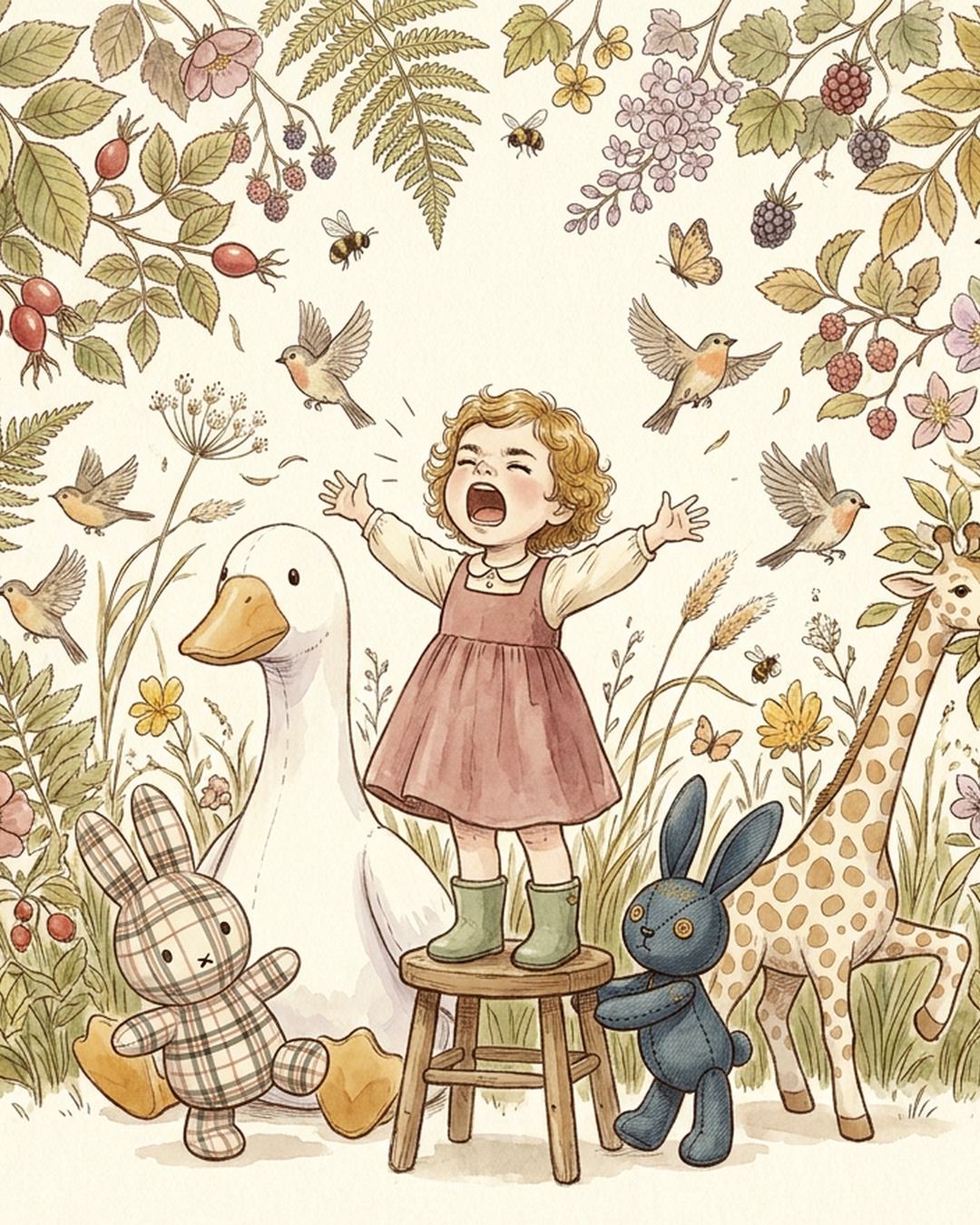
Firefly Jar paints your child onto that stool from your photos, with two to four of their own toys looking up. There are 27 lines to finish over 32 pages. It comes as a PDF for $49, usually emailed within a day (often in a few hours), and you can print it anywhere. There is also a printed hardcover for families in the US and Canada, $79 including the PDF ($95 for Canada), which arrives within 7 to 12 days.
Order their copy and leave every pause for them.
Frequently asked questions
What is a call and response book?
A picture book built so the grown-up reads one part and the child says the other, through a repeated refrain, a rhyme at the end of each page, a question with one answer, a song or a list that grows.
What are good call and response books for toddlers?
For two- and three-year-olds: Brown Bear, Brown Bear, What Do You See?, Is Your Mama a Llama?, Peek-a-Who?, Chicka Chicka Boom Boom and Pete the Cat: I Love My White Shoes. Each has a short part that comes back on every page.
What are good call and response books for preschoolers?
For four- and five-year-olds: We're Going on a Bear Hunt, Don't Let the Pigeon Drive the Bus!, The Napping House and There Was an Old Lady Who Swallowed a Fly. Their chants, questions and growing lists give an older child a longer part.
How do I read a call and response book so my child joins in?
Read it straight through the first time. From the second reading, slow down before the gap, look up at your child and hold the pause for a few seconds. Point at the answer in the picture, and when the word comes, carry straight on in the rhythm.
Can any picture book be read as call and response?
Yes. Leave the rhyming word, the main character's name or a noise for your child to say, ask about something drawn on the page, or add your own line at every page turn.
Gal, Naomi's dad
Make one for your child