 Firefly Jar
Affirmations for kids by age: 40 short lines for 2 to 6 year olds, and how to say them
A good affirmation for a young child is short enough to say in one breath, true enough to believe and said at a real moment: at the mirror, at the school gate, at bedtime. Below are 40 lines, grouped by age from 2 to 6, each with a moment to say it. Pick two or three. Say them every day for a week before you add more.
Three rules for any age
- Short. A child should be able to say the line in one breath. If you need a comma, the line is too long.
- True. Say what is already true, or what you are working on together. "I am learning" is true for every child. "I am the best at everything" is not, and a child can tell.
- Repeated. The same few lines, often, beat a new list each week. Children enjoy knowing what comes next.
The age bands below are our own rule of thumb from how toddlers and preschoolers talk. They are not a research result. A late talker at four can start at the two-year-old lines. A confident three-year-old can borrow from the fours.
How to say them
- Say the line yourself first, calmly, at the child's eye level.
- Keep your tone ordinary. Say the line warmly, in your normal voice.
- Pair it with an action: a hand on the chest, a hug, a jump.
- Stop when your child loses interest. Thirty seconds is a good session at two.
- Let your child change the words. A child who rewrites "I am brave" as "I am a brave dinosaur" has made the line theirs.
Ages 2 to 3: eight lines with an action
At this age, one or two words are plenty and the action does half the work.
| Line | Pair it with |
|---|---|
| I am loved. | A hug, any time |
| I am safe. | Hand on your child's back at bedtime |
| I can try. | Before a puzzle or a first go at stairs |
| I can do it myself. | Putting on a shoe |
| My body is strong. | A jump or a stretch |
| I am kind. | Giving a toy a cuddle |
| I use my words. | When a feeling is big |
| I am here. | Waking up, with a wave |
Age 4: eight lines for the "why" stage
Four-year-olds ask why, and they like to hear a reason. Give lines with a small because built in.
| Line | Pair it with |
|---|---|
| I can learn new things. | Learning to ride a scooter or draw a shape |
| My voice matters. | At dinner, when they want to say something |
| I can ask for help. | When a zip sticks |
| I am a good friend. | Before a playdate |
| I can try again. | After a block tower falls |
| I tell the truth. | After a small mistake |
| I am brave enough to try. | At the edge of a new playground |
| My feelings are okay. | When they cry |
Age 5: eight lines for school mornings
Five-year-olds face rooms of other children. Lines about belonging, effort and being seen help. They may start whispering the lines in the car.
| Line | Pair it with |
|---|---|
| I belong here. | At the school gate |
| I can do hard things. | Before a spelling try or a new skill |
| Mistakes help me learn. | After a wrong answer |
| I can wait my turn. | In a queue or a game |
| I can listen and share. | At circle time |
| I am proud of my work. | Showing a drawing |
| I can say no kindly. | When a friend asks for something they don't want to give |
| I can be calm. | A slow breath before a test, a show or a fight |
Age 6 and up: eight lines they can own
Six-year-olds can write and read the lines. Let them choose and write the ones that matter to them.
| Line | Pair it with |
|---|---|
| I am more than my mistakes. | After a bad day |
| I can finish what I start. | Homework or a long puzzle |
| I choose how to treat people. | After a fight with a sibling |
| I can be myself. | When they feel different |
| I am allowed to ask questions. | A class they find hard |
| I can try something new. | The first week of a club |
| I can say sorry and mean it. | After a conflict |
| I am learning every day. | Bedtime review |
Eight lines for hard moments
Keep these for the moment, not for the morning routine.
| Moment | Line |
|---|---|
| First day somewhere new | I am brave, and I am not alone. |
| A fall or a scraped knee | I am okay. I can get up. |
| A fight with a friend | I can fix this, and I can ask for help. |
| A big, loud feeling | I can breathe, and the feeling will pass. |
| A test or a show | I did my best, and that is enough. |
| Before a shot or a doctor | I can do hard things. |
| After you lose your temper | (You say) I am sorry. I love you, always. |
| A bad dream | I am safe, and I am home. |
The line for after you lose your temper is for you to say, not the child. A grown-up apology is one of the most useful things a child hears.
Make it call and response
Call and response means you start a line and your child finishes it. It turns saying into doing, and a child who is shy about speaking can often say the last word.
- Start with two or three words. "I am brave..." and pause.
- Wait. Count to five in your head. The silence is the invitation.
- Let the child finish. "...enough to try."
- Say it back, warmly. "Brave enough to try."
- Swap. Let your child start the line and you finish it.
This works in the car, on a walk and in the bath, and it works at bedtime. It does not need a book.
When your child says "no, I am not"
Some children push back. It is normal, and the pushback tells you something.
- Do not argue. "Yes you are" turns it into a fight.
- Ask. "What makes it feel not true today?" Children often answer.
- Change the line to something true. "I am brave" becomes "I am learning to be brave." "I am a good friend" becomes "I can be a good friend."
- Drop it for the day. Try again tomorrow.
One study points the same way. A well-known study of adults found that people with low self-esteem felt worse after repeating "I'm a lovable person" than people who did not repeat it, while people with high self-esteem felt somewhat better (Wood, Perunovic and Lee, Psychological Science, 2009). That was a study of adults, not children, and it tested one sentence. We did not find a trial of "I am" statements in two to six year olds, so we cannot tell you what the research says for your child. The practical lesson is the one in the rules above: pick lines your child can believe.
If your child often says very negative things about themselves, or seems anxious or sad for weeks, talk to your child's doctor or a counsellor. Affirmations are a family habit, not a treatment.
Where Firefly Jar fits
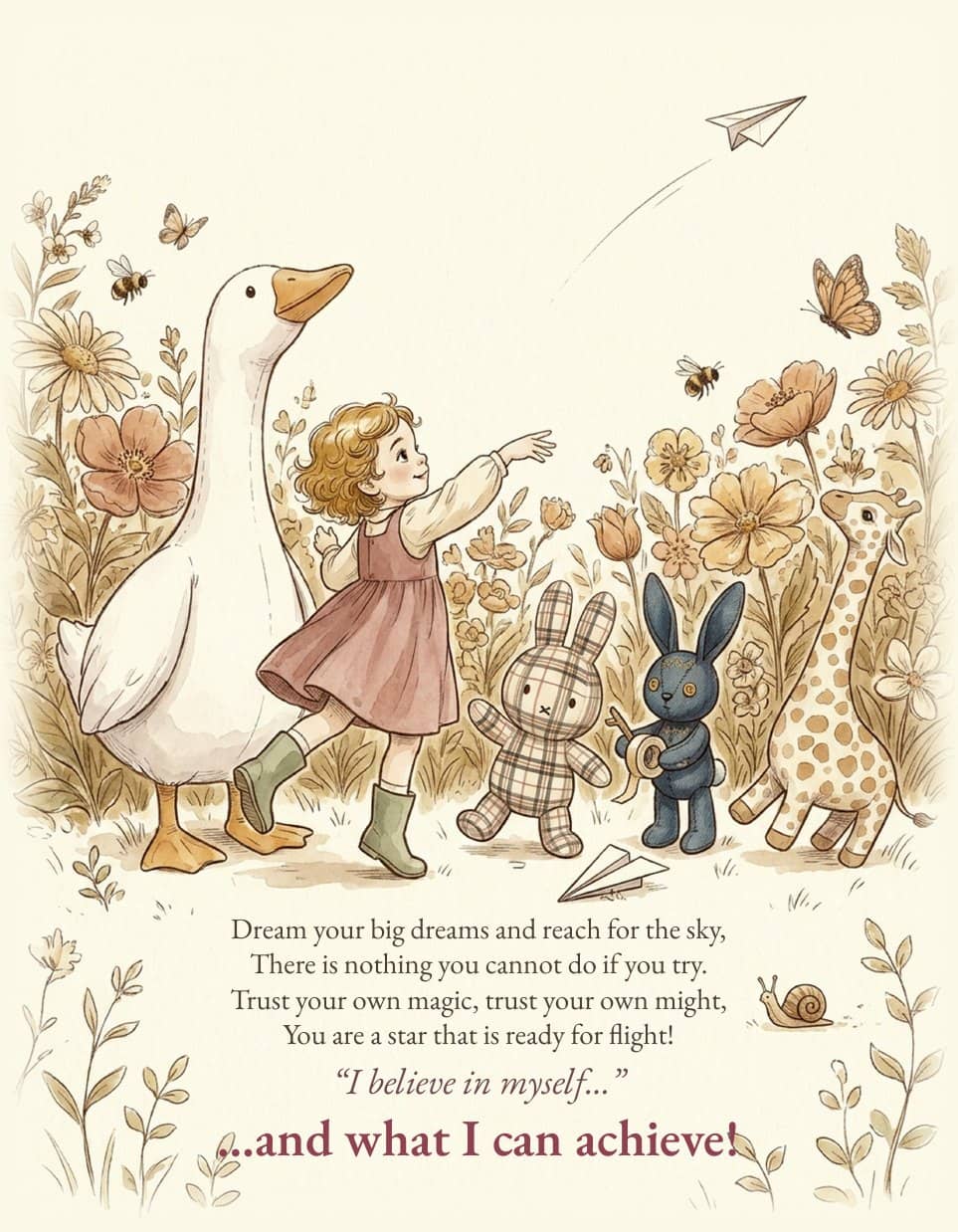
Firefly Jar is a personalised picture book for your child, painted from the photos you upload and built on one idea: call and response. The book has 27 affirmations, one on each page. You read a four-line rhyme, then you start the affirmation and your child finishes it. On one page you say "I believe in myself..." and your child answers "...and what I can achieve!" On another you say "I am safe, I am loved..." and your child answers "...and I belong here!" Your child and two to four of their own toys are on every page.
The page below is a real page from Naomi's book, the one the founder made for his daughter. It costs $59 as a PDF for you to print or read on a screen. A printed hardcover is coming at $79. The book arrives by email almost anywhere in the world (not yet in the United Kingdom); the printed hardcover ships to the United States and Canada. The book is at fireflyjarbooks.com. The 40 lines on this page are free to use with or without it.
Frequently asked questions
What affirmations should I say to a 3 year old?
Short ones with an action: "I am loved", "I can try", "My body is strong". See the ages 2 to 3 table above.
At what age can I start saying affirmations with my child?
Whenever your child can hear you. Toddlers join in with the last word of a line around two. Do not push; stop when they lose interest.
How do I make affirmations a call and response?
Say the first half of a line, pause for a count of five and let your child finish it. Then swap.
What if my child says an affirmation is not true?
Do not argue. Ask what makes it feel untrue, then change the line to something true, such as "I am learning to be brave".
Do affirmations work for kids?
Nobody can promise it. The one study we cite was on adults, not children. What we can say is that a short line your child believes, said at a real moment, is easy to keep up.
Gal, Naomi's dad
Make one for your child